_edited.png)
Oestrogens greatest Hits! Teenage Hormones and Perimenopause at the same time? When havoc occurs in the same household.

Clash! Things are changing! Living with a daughter through the teenage years can be challenging enough, but when this is coupled with your own perimenopausal symptoms, tensions and emotions in the same living space may well intensify. On both sides, the physical and emotional upheavals driven by the parallel journeys of hormonal changes can make everyday life feel impossible.

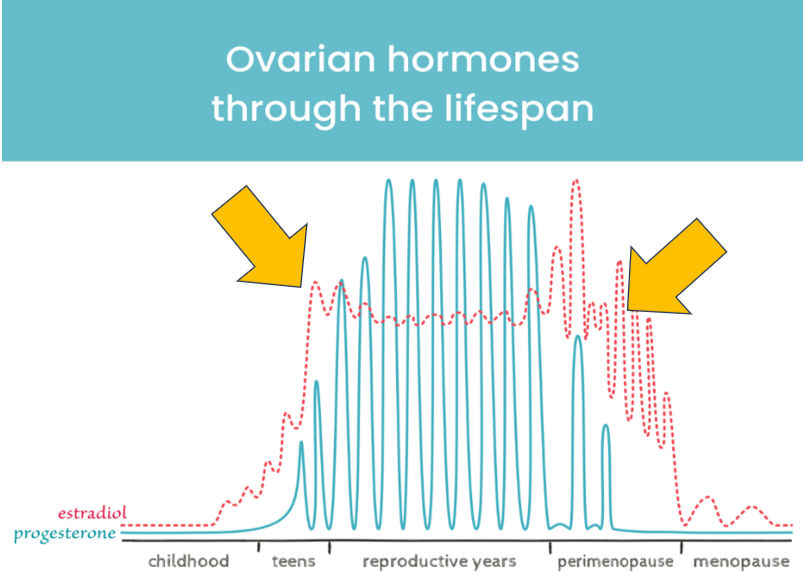
Mood changes, anxiety, bouts of depression, weight gain, rogue hair growth on the body are signs puberty has arrived - but ironically, also, that perimenopause has arrived. The teenage hormonal change is rapid and on the increase, whilst the perimenopause hormonal change is slower and on the decline.
This topic isn't widely discussed, yet it is widely relevant. So let's explore some of the similarities between puberty and perimenopause, and then identify some solutions that might help alleviate the challenges of these turbulent years.
Mood Swings due to hormone havoc
On both sides, increased anxiety, a heightened emotional sensitivity or irritability, can be present. This is due to changes in the chemistry of the female brain. Oestrogen functions as a regulator to ensure the brain responds appropriately to signalling, giving metabolic and emotional stability. The Amygdala, (responsible for emotion and motivation); the Hypothalamus, (responsible for sleep, balance, food intake), the Prefrontal Cortex, (executive function, learning and working memory) among other areas, are all affected during these two parallel life stages.
A girl's brain is still in development, while a middle-aged woman might experience fogginess and lack of clarity in her brain due to reduced oestrogen levels.
Body pains and aches
On both sides, there might be a sense of discomfort with their changes in shape. At 14, a girl will see quite rapid body shape changes; wider hips, broader shoulders, a shift in the centre of gravity that can make some sports like running more difficult. By the age of 45, a woman might notice weight gain, particularly around her midsection, and feel frustrated with exercise programs or diet regimes that appear ineffective.
Girls may experience 'growing pains'. During rapid growth spurts, long bones (such as the femur and tibia in the leg) lengthen at a rate faster than the muscles can adapt to. Perimenopausal women can experience a sudden onset of joint pain. Problems in the more flexible joints (neck, hip, knee, shoulder, ankle or wrist) where the effects of reduced oestrogen levels that have beneficial anti inflammatory properties, affect stability and movement.
Sleep
On both sides, sleep is disrupted by hormonal change. In the early teenage years, and more so in late teenage, the biological circadian rhythm shifts by 1-2 hours, making them less tired at night. Whilst you, peri or post menopausal want nothing more than a tea and are done by 9pm! Once again the driver is hormonal change with melatonin being released later in adolescents.
The hormone progesterone is responsible for feelings of calmness; for sleep and the parasympathetic nervous response. In girls progesterone is slow to get going - hence poor emotional regulation - and in perimenopausal women, it drops off early and quickly, leaving a state known as oestrogen dominance.
Identity
On both sides, questions such as, "Who am I? Who was I? Who will I become?" The girl-woman reflected in the mirror may seem unfamiliar. This body has changed without my consent, and I feel powerless over it! Perhaps the most challenging aspect, which is seldemly acknowledged, is the sensation of bidding farewell, a slight grief, that a past self - the child or the younger woman is no longer there.
Stress
On both sides there could be a feeling of overwhelm. Behavior change in teenage girls can be driven by external factors such as increased pressures from school, academic study, or social media. For the midlife woman stress levels may be rising due to the demands of work, home, ageing parents or simply exhaustion from the seemingly endless days of care giving and organising.
Hormone changes
All these parallels are driven by hormone changes. The ovarian hormones within the lifespan of a biologically born XX female dominate their physical, emotional and mental well being. When progesterone is reduced, oestrogen is hitting hard and this explains why tensions, anxiety, and turbulence between your teenager and you can occur.
Solutions:
Its always important to pay attention to women's physical and mental well being. But never perhaps more than during these years of oestrogens greatest hits! With young adulthood (25 - 35 years) comes stability, likewise, with post menopause (Ca. 51 years onwards). So good news! It WILL pass! But during these in between years it's crucial to pay attention to the foundations of health and what is controllable:
Food and nourishment - finding the right eating habit for you. Not limiting food as a tool for self image, but rather as a foundation of future health. Difficult for both girl and midlife woman in a visually driven media world.
Movement - for both physical vitality and mental sharpness. Mobility, strength training, sports and walking are essential for long term health.
Stress management - staring the day with calm and finding balance, within the demands and challenges of modern daily life
Rest and sleep - The female circadian rhythm operates in cycles. Be it a 24 hour day or a 28 day reproductive cycle. It helps to acknowledge these rhythms and work with them. Being over productive when the body is asking for rest only increases stress and disrupts sleep.
Supplementation - hormonal or nutritional - Exploring available options for nutrient support or hormonal therapy might be beneficial. Consulting a trustworthy nutritionist or gynecologist can provide guidance during these transitional years.
Supportive relationships and connections - nurturing meaningful relationships and friendships, talking, sharing and having fun and relaxation can help buffer stress. Not forgetting that these are important on the professional, or educational level well as on a personal level.
Patience! - It will pass! Time moves on and the female body grows into it's next phase. On both sides, (but perhaps more on the midlife side), patience is a helpful tool. Armed with knowledge and scientific information, and a little experience from Mum, these transitions could be a time to share joint frustrations, all be it form different perspectives.
Whether it is a daughter, stepdaughter, niece, granddaughter, friend's daughter, sister, or stepsister, recognizing this life stage as a transitional period when challenges might arise, and understanding the similarities and parallels due to changing hormone patterns could be beneficial.
If you have a question; an experience you would like to share; or are looking for support in getting through this time then please get in touch.
Resources:
ROAR; Stacy T. Sims
Menstruation through the Lifecycle; Nicole Jardin.
Third Age Woman; Jenny Burrell Education
FIX MY PERIOD; Nicola Jardin
THE WELLBEING ADVANTAGE; Dr Janine van Someren


Comments